What Proper Trimming Does for a Lehigh Acres Tree
Proper trimming is surgery with a long horizon: every cut should make the tree safer, healthier, or better shaped five years from now, not merely tidier this week. In Lehigh Acres that means removing dead, crossing, and rubbing limbs, raising the canopy where it interferes with roofs, driveways, and walkways, and thinning crowded growth so wind passes through rather than pushing against a solid sail. It also means knowing when to stop. Over-thinning a live oak or stripping a pine invites sunscald, weak regrowth, and a canopy that is actually more vulnerable in the next storm, so our crews remove only what the tree can afford in a single visit and explain the plan before the first cut.
Species knowledge drives every decision. Live oaks need selective thinning that respects their broad, spreading architecture; slash pines need deadwood and lower-limb management rather than aggressive crown work; shade trees near pools need clearance that protects the cage without butchering the tree's form. Timing matters as well. Heavy structural pruning is best done when the tree can recover vigorously, and pre-hurricane-season work — typically spring into early summer — is scheduled deliberately so reductions and thinning are complete before June. Routine maintenance every two to four years, adjusted to species and age, keeps most Lehigh trees safe without ever needing drastic intervention.
Trimming Versus Topping: A Difference That Lasts Decades
The single most damaging practice we still encounter in Lehigh Acres is topping: cutting a tree's leader and main limbs back to stubs to control height. Topping does not make a tree safer. It destroys the tree's structure, triggers a flush of weakly attached shoots that grow faster and break more easily than the original limbs, and opens large wounds to decay and insects in Florida's warm, humid climate. A topped oak or pine often becomes more hazardous within a few years than it was before, while also losing the shade and form that made it valuable.
Our alternative is crown reduction done correctly: selective cuts back to lateral branches large enough to sustain the limb, preserving the tree's natural shape at a lower height. Where a tree has already been topped by a previous contractor, we can sometimes rehabilitate it over several visits by selecting the strongest regrowth and gradually restoring structure, though some topped trees cannot be fully saved and honesty about that is part of the assessment. If another company proposes topping your tree, ask them to explain the regrowth problem and the decay risk; if they cannot, call us at (239) 686-1550 for a second opinion before any saw starts.
Roof, Driveway, and Structure Clearance Done Right
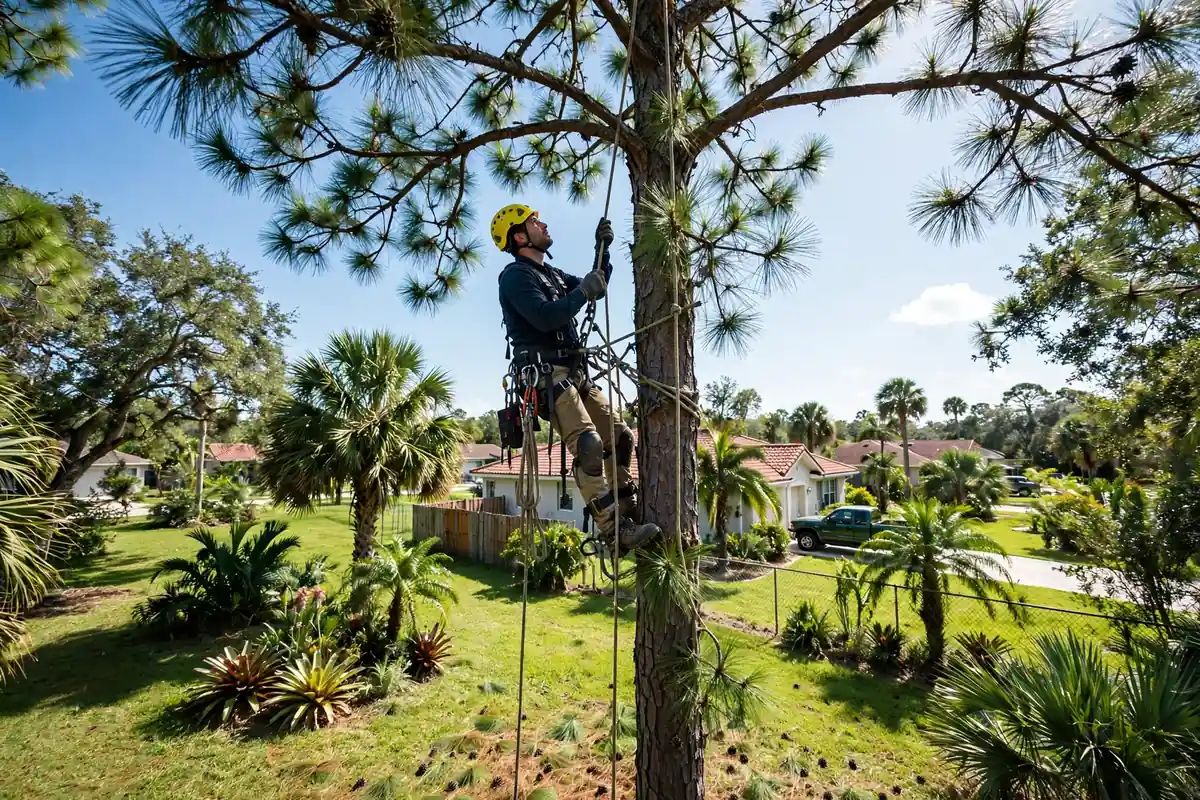
Much of our trimming work is clearance work: limbs over roofs, gutters, pool cages, driveways, and walkways. The goal is a sensible gap — enough that normal sway in a summer thunderstorm does not bring limbs into contact with shingles or screens — without stripping the tree bare on one side and unbalancing it. We work from the tree's structure outward, removing the limbs that actually threaten the structure and thinning the canopy above it so wind loads drop, rather than shearing everything within reach of the bucket.
Gutter and roof health improves immediately after good clearance work. Leaves and small debris drop less into gutters, limbs no longer scrape shingles in wind, and sunlight reaches roof surfaces that previously stayed damp and grew algae. Driveway clearance matters for safety too: low limbs force tall vehicles toward lawns and mailboxes, and a limb that brushes a delivery truck today becomes a broken limb on a car tomorrow. We discuss the clearance distances with you during the estimate, photograph the before state, and leave the canopy balanced rather than lopsided, because an unbalanced crown is itself a storm risk.
Deadwood, Crossing Limbs, and Canopy Health
Deadwood is the most underrated hazard in a mature canopy. Dead limbs have no living attachment strength left to lose; they fail without warning, in calm weather as well as storms, and they fall on roofs, cars, pets, and people. Our deadwood passes remove every dead limb we can safely reach, from pencil-sized twigs that clog gutters to heavy spars over driveways. We also remove crossing and rubbing limbs, which wound each other's bark and create entry points for decay and insects, and we thin interior growth that traps humidity and encourages fungal problems in Lehigh's wet summers.
Canopy health work extends beyond cutting. During a trimming visit we note signs that deserve follow-up: fungal brackets, bark abnormalities, insect activity, root-zone damage from mowing or trenching, and irrigation patterns that keep a trunk wet. Those observations feed into your written summary, so a trimming visit doubles as a health check. When a tree shows decline beyond what pruning can address, we say so and discuss treatment, cabling, or removal options with costs, rather than trimming a dying tree repeatedly and charging for work that cannot save it.
When to Trim, What It Costs, and How to Book
Most Lehigh Acres shade trees benefit from professional trimming every two to four years, with younger trees needing formative pruning more often and mature oaks needing lighter, less frequent passes. The best booking window for storm preparation is late winter through spring, before hurricane season begins in June, though deadwood and hazard limbs should never wait for a convenient season. Trimming is priced per tree after a free on-site assessment, because canopy size, species, access, and the amount of deadwood vary too widely for honest phone quotes; routine trims are quoted clearly in writing and scheduled within the same week in most cases.
From Lee Boulevard to Sunshine Boulevard, Town Lakes, Village 20, Parkdale, and the acreage roads beyond, our crews trim the trees that shade Lehigh Acres homes and keep them safe doing it. Call (239) 686-1550 for a free on-site trimming estimate, and we will walk your property, explain what each tree needs and what it does not, and leave a written quote with no pressure. Good trimming is quiet work — no drama, no topped trees, no mess — and its value shows up exactly when it matters: in the next big storm.
Trimming Mistakes We Are Called to Fix
A surprising share of our trimming work is corrective: trees damaged by previous contractors whose methods created the very hazards they were hired to prevent. Topped oaks sprouting weak, fast-growing shoots; lion-tailed pines with long, end-heavy limbs that snap in wind; palms stripped to poles and now narrowing at the trunk; hardwoods with flush cuts that never closed and now harbor decay. Corrective pruning is slower and more expensive than doing the job right the first time, because it must select the strongest regrowth, remove the weakest, and rebuild structure over several seasons rather than in a single visit — and some trees, honestly, cannot be fully restored.
The lesson for homeowners is to judge a trimming proposal by its method, not its price. A suspiciously cheap trim that tops, strips, or shears a tree is not a bargain; it is a future removal, a future roof repair, or a future liability, purchased in advance. Ask any contractor to explain their cuts, their canopy percentage, and their policy on topping, and be wary of any answer that treats those questions as unimportant. Our estimates answer them before you ask, with the cuts described, the percentage stated, and the tree's long-term health treated as the deliverable — because a trim that damages a tree has failed even if the yard looks tidy that afternoon.
What It Costs in Lehigh Acres
| Trimming job | What we do | Typical scheduling |
|---|---|---|
| Canopy thinning | Selective interior removal for wind flow | Every 2–4 years |
| Roof / structure clearance | Gap + canopy balance over structures | As growth requires |
| Deadwood pass | All dead limbs safely reachable | Annually for mature trees |
| Formative pruning | Structure for young trees | Every 1–2 years while young |
| Storm preparation trim | Thinning + reduction before June | Spring, before hurricane season |
Every job is quoted free on site, so the number you approve is the number you pay. Call (239) 686-1550 and we will walk the property with you, explain the options in plain language, and leave a written estimate.
What Our Customers Say
Our oaks look natural, not butchered, and the roof clearance is perfect. They explained every cut.
No topping, no mess, and the canopy is noticeably lighter in wind. Real professionals.
They trim our whole property every two years. The trees are healthier and the yard is safer.
Frequently Asked Questions
How often should my trees be trimmed?
Most shade trees every 2–4 years. Young trees need formative work more often, and mature trees need lighter passes. Deadwood should be removed whenever it appears.
Do you top trees to reduce height?
No. Topping damages structure and creates weak, hazardous regrowth. We reduce crowns properly, cutting back to suitable laterals.
How is trimming priced?
Per tree after a free on-site assessment, based on size, species, canopy condition, and access. You receive a written quote before work.
Will trimming help in a hurricane?
Yes. Thinning and proper reduction lower wind load and remove the deadwood most likely to become debris, though no trimming makes a tree storm-proof.
Do you clean up trimmings?
Yes. We chip brush, haul debris, rake, and blow the area, and walk the property with you afterward.
When is the best time to trim?
Late winter through spring for storm preparation, but hazard deadwood should be removed any time of year.
Ready to Get Started?
Free on-site estimates across Lehigh Acres, Monday to Saturday, 7:00 AM to 6:00 PM. Licensed & insured crews, tidy cleanup, honest pricing.
Find Us in Lehigh Acres, FL
We serve homes and businesses throughout Lehigh Acres and Lee County.