Why Lehigh Acres Roots Cause So Many Problems
Lehigh Acres soil is the root of the root problem, literally. Sugar sand offers little resistance and little deep moisture, so trees grow wide, shallow root plates that spread far beyond the canopy drip line in search of water. That strategy works for the tree and fails for everything built nearby: sidewalks heave, driveway slabs tilt, pool decks crack, and irrigation and septic components get invaded by roots seeking moisture. A live oak twenty feet from a walkway can lift it within a decade, and a pine near a drain field can send roots into perforated pipe that was never designed to resist them. The problem is rarely one root; it is a system of roots responding rationally to sandy soil, irrigation, and the moisture gradient around a home.
The first step is always diagnosis, not cutting. We trace which tree owns the offending roots, because roots from a neighbor's tree, a removed tree's surviving system, and your own tree all demand different solutions and different conversations. We probe the root's size, depth, and direction, check how much of the tree's anchorage and nutrition depends on it, and assess the structure it threatens: a lifted sidewalk section, a cracked pool deck, a septic line, or a foundation edge. Cutting a major structural root on a tree you intend to keep can destabilize it, especially in shallow soil, so the plan must balance the concrete against the canopy above it.
Root Removal for Trees That Are Staying
When the tree stays, root removal is selective surgery. We expose the offending roots by hand or with careful excavation, cut them at a point that gives the structure room — typically beyond the repair zone, with a root barrier considered where appropriate — and treat the cut to discourage rapid regrowth into the same spot. The work is sequenced with the concrete or pool repair whenever possible, so the slab is not poured over roots that will heave it again in two years, and the tree is not cut twice for two separate contractors. For sidewalk and driveway roots, we coordinate with the concrete contractor on the repair footprint, because the cheapest root job is the one done once, correctly, before the new slab goes down.
Not every root near a structure should be cut. A root that provides a large share of a leaning tree's anchorage, or a root system already weakened by trenching on the opposite side, may make removal of the tree the safer overall answer, and we explain that trade-off plainly rather than selling a root job that endangers the tree. Conversely, a healthy tree with a single offending surface root can often keep both its stability and its shade after a careful, limited cut. Our written summary states which roots were removed, what barrier or repair coordination is recommended, and what monitoring the tree needs afterward, so the next contractor who works on the property starts from facts rather than guesswork.
Root Removal After a Tree Is Gone
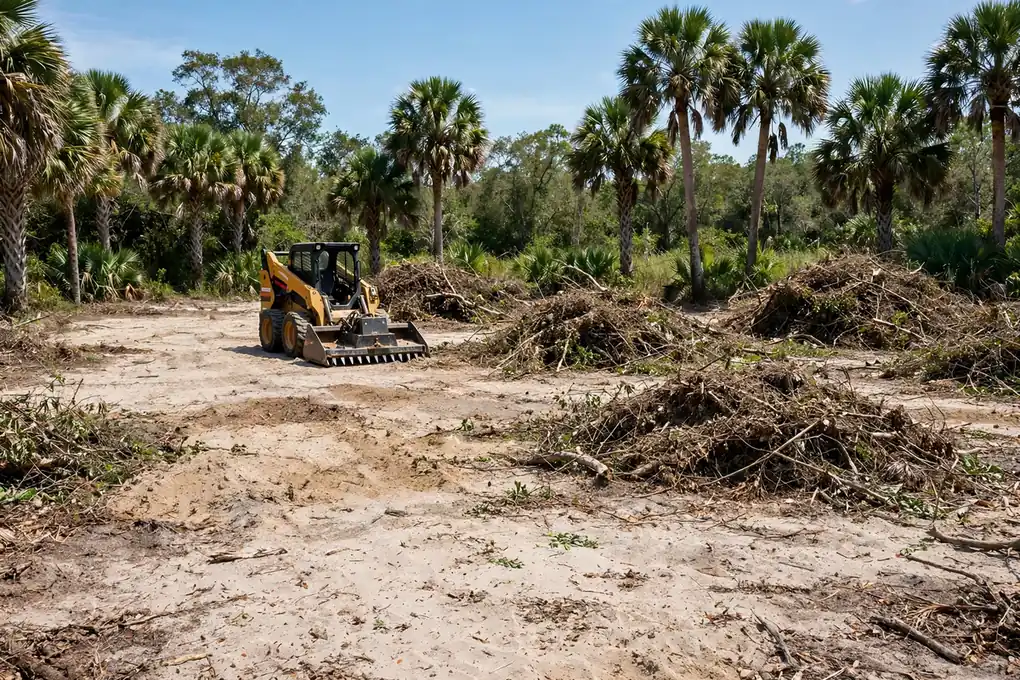
After a removal, the root question changes completely: the tree no longer needs its roots, so the constraint becomes structures, utilities, and your plans for the ground. Surface roots and the root flare are typically ground with the stump, but deeper or far-spreading roots may remain, and whether they matter depends on what goes above them. Roots under a future lawn can decay harmlessly over a few seasons. Roots under a new driveway, slab, or pool deck should be excavated, because decaying roots leave voids that settle unevenly under rigid surfaces. Roots in a septic drain field are a special case: they must be removed and the field assessed, because root intrusion is often the symptom of a field that needs professional attention beyond tree work.
We coordinate with septic, pool, and concrete professionals on these jobs rather than working in isolation. The sequence usually runs: locate utilities and field components, excavate and remove the roots in the repair or construction zone, grind or remove the stump, backfill and compact in layers, and document what remains outside the zone for future reference. That documentation matters when a future owner or contractor digs in the same area. Prices for post-removal root work depend on root size, depth, and the structures involved, and are quoted free on site alongside or after the removal estimate.
Root Barriers, Repairs, and Preventing a Repeat
Cutting a root without addressing why it grew there invites a repeat. Root barriers — vertical panels installed between a tree and a structure — redirect future growth downward and away, and they are most effective when installed during a repair, while the ground is already open. We discuss barriers honestly: they help with single trees and defined boundaries, they are less useful where multiple trees or a dense root mat are involved, and they must be installed to sufficient depth in sandy soil to actually redirect growth rather than being bypassed underneath. Irrigation adjustments matter too: a leaking head or a bed watered daily next to a walkway trains roots toward the moisture, and fixing the water source is sometimes more effective than cutting the root.
For new plantings, prevention is cheaper than any removal. Trees should be planted at distances matched to their mature root spread — not their nursery-pot size — with particular care near slabs, pools, septic fields, and driveways. During an estimate we advise on spacing for replacement trees, species with less aggressive root behavior near structures, and root-zone practices such as avoiding soil piling against trunks and avoiding trenching through established root plates. A few minutes of placement advice at planting time prevents thousands of dollars of concrete and root work later, and it is advice we give freely whether or not you hire us for the planting.
Booking Root Removal in Lehigh Acres
Root removal is quoted free on site, because no two root problems are alike: the tree, the structure, the soil moisture, and the repair plan all shape the work. We serve Lehigh Acres neighborhoods from Lee Boulevard and Homestead Road to Sunshine Boulevard, Town Lakes, Village 20, Leeland Heights, and Parkdale, plus Fort Myers, Cape Coral, Gateway, Buckingham, Alva, and North Fort Myers. Same-week scheduling is common for urgent cases where a root is actively damaging a pool deck or blocking a repair, and we coordinate timing with your other contractors where a repair sequence demands it.
Call (239) 686-1550 and describe the symptom — a lifted slab, a cracked deck, roots in a drain field, or a mower hazard across the lawn — and we will schedule a visit to trace the cause and quote the fix. Root problems reward early attention: a root cut while it is small and a slab repaired before it cracks through are both far cheaper than the same jobs a year later. Our job is to protect your structures without unnecessarily sacrificing a tree, and to leave you with a repair that lasts.
Roots and New Planting: Spacing That Prevents the Next Problem
Every root problem is, at its origin, a planting-distance problem, and the fix for the next generation is spacing discipline. A live oak's roots will spread two to three times its canopy width in sandy soil; a slash pine's roots will seek the moisture around a septic field from surprising distances; a palm's fibrous root ball stays comparatively compact but still needs clearance from pool plumbing. When we advise on replacement planting, we give distances in mature terms — where the tree will be in twenty years, not where it is in its pot today — and we flag the structures that matter most: slabs, pools, septic fields, driveways, sidewalks, and buried utilities. Those numbers, written in your summary, are worth keeping with your property records.
Soil practices after planting matter too. Piling soil or mulch against a trunk, trenching through an established root plate for irrigation or lighting, and compacting soil with heavy equipment over a root zone all damage roots in ways that show up years later as decline or instability. We advise on root-zone protection during any construction near a kept tree — fencing the critical root zone, avoiding grade changes within it, and routing trenches around rather than through it — because protecting roots during a project is vastly cheaper than removing them afterward. A tree's roots are its foundation, and in Lehigh's sand, that foundation deserves the same respect as the slab it grows beside.
What It Costs in Lehigh Acres
| Root problem | Our approach | Coordination needed |
|---|---|---|
| Lifted sidewalk / driveway | Selective cut + barrier advice | Concrete repair contractor |
| Cracked pool deck | Careful cut, structure-safe depth | Pool contractor |
| Septic field intrusion | Excavate in zone, field assessment | Septic professional |
| Roots after removal | Grind flare, excavate if building | Builder / concrete plan |
| Mower hazard surface roots | Grind / remove surface roots | Usually standalone |
Every job is quoted free on site, so the number you approve is the number you pay. Call (239) 686-1550 and we will walk the property with you, explain the options in plain language, and leave a written estimate.
What Our Customers Say
Lifted sidewalk fixed properly — roots cut, barrier advised, and the new slab has stayed level for two years.
Pool deck roots handled without harming our oak. Coordinated perfectly with the pool contractor.
Honest crew: they told us one root could not be cut safely and removal was the better call. We agreed.
Frequently Asked Questions
Can roots be removed without killing the tree?
Often yes, when the cut is selective and the tree retains enough anchorage. We assess stability first and advise honestly when removal is safer.
Do you install root barriers?
We advise on and coordinate barrier installation during repairs, and explain honestly where barriers help and where they do not.
How much does root removal cost?
Quoted free on site by root size, depth, structures involved, and coordination needed. It is often combined with stump grinding.
Should roots be removed before pouring new concrete?
Yes. Pouring over live roots guarantees future heaving. Sequence the root work before the slab.
What about roots in a septic drain field?
They need excavation plus a septic professional's assessment of the field itself, which we coordinate.
Can a removed tree's roots damage a new slab?
Decaying roots leave voids that settle unevenly, so roots under future slabs or driveways should be excavated, not left.
Ready to Get Started?
Free on-site estimates across Lehigh Acres, Monday to Saturday, 7:00 AM to 6:00 PM. Licensed & insured crews, tidy cleanup, honest pricing.
Find Us in Lehigh Acres, FL
We serve homes and businesses throughout Lehigh Acres and Lee County.