How a Dense Crown Becomes a Storm Liability
A mature live oak or slash pine in Lehigh Acres can carry a canopy so dense that summer thunderstorms and tropical winds treat it as a solid object. Wind pressure rises with the square of wind speed, and a closed canopy transfers that entire force into the trunk and into shallow, sandy-soil roots that were never designed to resist it alone. The result is familiar after every major storm: whole trees uprooted with root plates lifted, large limbs torn at weak unions, and codominant stems split down the middle. Crown thinning addresses the physics directly by selectively removing interior branches so air moves through the canopy, reducing the sail effect without changing the tree's outward shape.
Thinning is not the same as shearing or rounding a tree. A thinned crown looks almost unchanged from the street, which surprises homeowners who expect a visibly smaller tree. The work happens inside: crossing limbs, water sprouts, and crowded interior growth come out, light reaches the inner canopy, and remaining limbs gain the air circulation that discourages fungal disease in humid Lee County summers. Done properly, thinning typically removes no more than fifteen to twenty-five percent of the live canopy in one visit, because removing more shocks the tree and triggers the weak, fast regrowth that creates future hazards.
Crown Reduction: Lowering Height Without Topping
Crown reduction is the correct answer when a tree has simply outgrown its space: a pine towering over a roofline, an oak pressing toward a second-story window, or a canopy reaching into a service corridor. Unlike topping, which hacks limbs back to stubs, reduction cuts selected limbs back to lateral branches at least one-third the diameter of the removed portion, so each remaining limb has a living leader capable of sustaining it. The tree ends up shorter and narrower, its natural form preserved, and its wounds sized to close rather than rot.
Reduction decisions always weigh the tree's species and age. A vigorous young oak tolerates a meaningful reduction and responds with balanced regrowth; an older, declining pine may not, and in that case a smaller reduction combined with deadwood removal and monitoring is the honest recommendation. We also consider what sits beneath the canopy: a reduction over a pool cage or driveway needs rigging for every piece, while a reduction in open ground can proceed faster. During the free estimate we show you which limbs would come back and by how much, so the result is never a surprise when the bucket comes down.
Thinning, Reduction, and the Rest of the Canopy Plan
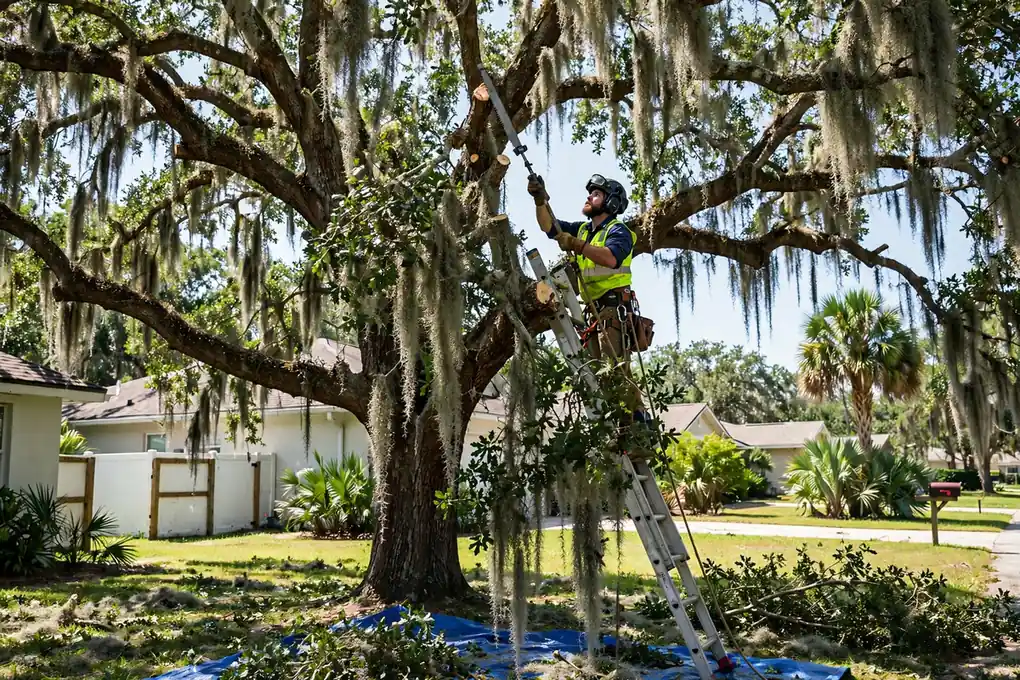
Thinning and reduction rarely happen in isolation. A typical crown job in Lehigh Acres also includes deadwood removal, because dead limbs inside a newly opened canopy are still the first pieces to fail, and clearance work where limbs overhang a roof or driveway. We sequence the work from the inside out: deadwood first, then thinning cuts, then reduction cuts, then a final step back to view the crown from the ground and correct any imbalance. That last step matters more than it sounds; a crown thinned heavily on one side catches wind unevenly, and an unbalanced tree can be more dangerous than the dense one it replaced.
For trees near power service lines, crown work coordinates with clearance requirements, and we never cut into the zone around energized lines without the proper approach. For HOA properties, we document the before and after canopy so a board can see that the tree was cared for rather than damaged. And for trees with structural defects — a weak union, a cavity, a history of splitting — crown work may be paired with cabling and bracing, which limits movement at the defect while the reduced canopy lowers the forces acting on it. The pages for those services explain the combination in detail.
Which Lehigh Trees Benefit Most
Live oaks benefit enormously from thinning because their broad, spreading crowns trap wind and their dense interior growth shades out lower limbs, which then die and become deadwood. Slash pines benefit from a different emphasis: removal of dead lower limbs and reduction of top-heavy crowns that lean toward structures after years of growth in sandy soil. Mature shade trees planted close to homes in the older Lehigh neighborhoods near Lee Boulevard and Homestead Road are prime candidates, as are trees on newer lots where builder-planted species have grown faster than their spacing allowed.
Not every tree should be thinned. A palm is not thinned like a hardwood — its crown is managed by frond work, not interior cuts — and a severely declining tree may be weakened further by canopy removal, in which case assessment and possible removal are the honest path. Young trees generally need formative pruning rather than thinning, shaping their structure while cuts are small and wounds close fast. Our estimate distinguishes these cases tree by tree, so you never pay for crown work on a tree that needed a different service or no service at all.
Timing, Cost, and Booking Crown Work
The ideal window for crown thinning and reduction in Lehigh Acres is late winter through spring, finishing before hurricane season opens in June, when the work has the greatest protective value. That said, a hazardous crown — heavy deadwood, a cracked union, limbs over a bedroom — should not wait for the ideal season. Crown work is priced per tree after a free on-site assessment, reflecting size, species, canopy density, access, and rigging needs; most routine crown jobs on a single mature tree are completed in a few hours, including cleanup, and multi-tree properties are quoted as a package.
Call (239) 686-1550 to schedule a crown assessment anywhere in Lehigh Acres, from Sunshine Boulevard and Town Lakes to Village 20, Leeland Heights, and the corridors toward Fort Myers and Cape Coral. We will walk the property, explain what thinning or reduction would change for each tree, and leave a written quote. A crown that breathes is a tree that stands a far better chance in the next storm — and it keeps its shade, its shape, and its value while doing it.
Crown Work and Your Neighbors: Light, Views, and Boundaries
Crown thinning and reduction change more than one tree; they change light, views, and privacy across a neighborhood, and those side effects deserve discussion before cutting. Thinning a dense oak can brighten a neighbor's yard as well as yours, which is usually welcome, while reducing a tall pine can open a view corridor that affects two properties' privacy at once. Boundary trees — trunks on one lot with canopies over another — are particularly sensitive, and Florida's rules about overhanging limbs are frequently misunderstood. We document boundary crowns, advise on communication with neighbors before work, and keep cuts within the agreed scope, so a crown job improves a street rather than starting a dispute on it.
Light is the other side effect worth planning. A thinned canopy admits dappled sunlight that transforms a previously dark lawn, often allowing grass or beds to thrive where they previously struggled, while a reduced crown can change shade patterns on a roof, a pool, or a patio in ways that affect cooling and comfort. We discuss those changes during the estimate, including where new sun exposure may stress shade-loving plantings beneath the tree, so you can plan beds and irrigation accordingly. Crown work done thoughtfully improves the whole property's ecology, not just the tree's storm performance, and that broader view is part of every crown assessment we perform.
What It Costs in Lehigh Acres
| Crown service | What changes | Canopy removed per visit |
|---|---|---|
| Thinning | Interior density, wind flow | Typically 15–25% |
| Reduction | Height and spread | Selective, to live laterals |
| Deadwood + thinning | Safety + airflow combined | Deadwood fully, live sparingly |
| Clearance + reduction | Structure gap + lower load | As site requires |
| Not recommended | Palms, severely declining trees | Different service instead |
Every job is quoted free on site, so the number you approve is the number you pay. Call (239) 686-1550 and we will walk the property with you, explain the options in plain language, and leave a written estimate.
What Our Customers Say
After thinning, our oak survived the last tropical storm without losing a limb. The canopy looks untouched but moves differently in wind.
They reduced a pine over our roof properly — no stubs, no shock, and it looks natural.
Honest advice: they thinned two trees and told us the third needed removal instead. That honesty kept our business.
Frequently Asked Questions
What is the difference between thinning and reduction?
Thinning removes interior branches to let wind pass through, keeping the outline. Reduction shortens height and spread by cutting back to live laterals. Many jobs combine both.
Will thinning change how my tree looks?
Very little from the street. The work is inside the canopy, so the tree keeps its natural shape while becoming safer and healthier.
How much canopy can be removed at once?
Usually 15–25% of live canopy. Removing more stresses the tree and triggers weak regrowth.
Is crown reduction the same as topping?
No. Topping cuts to stubs and damages trees. Reduction cuts back to laterals that can sustain the limb and close the wound.
When should crown work be done?
Late winter through spring is ideal, before hurricane season, but hazardous crowns should be addressed any time.
How is crown work priced?
Per tree after a free on-site assessment, based on size, species, density, and access.
Ready to Get Started?
Free on-site estimates across Lehigh Acres, Monday to Saturday, 7:00 AM to 6:00 PM. Licensed & insured crews, tidy cleanup, honest pricing.
Find Us in Lehigh Acres, FL
We serve homes and businesses throughout Lehigh Acres and Lee County.