Why Deadwood Is the Quiet Hazard in Every Mature Canopy
Deadwood fails differently from live limbs, and that difference is what makes it dangerous. A living limb bends, signals distress, and usually fails during an obvious stress event. A dead limb has no flexibility left and no warning system; its attachment decays silently, and it can drop on a still, sunny afternoon onto a driveway, a pool deck, a pet, or a person walking beneath. In Lehigh Acres, where mature live oaks and slash pines shade most established lots, deadwood accumulates constantly: interior limbs shaded out by a dense crown, lower pine limbs that die as the tree grows taller, and storm-damaged stubs that never healed. Every mature tree carries some, and every year it is left in place, the risk and the removal difficulty grow.
The property damage pattern is just as predictable. Dead limbs puncture pool cages, dent cars, tear gutters, and punch through roof shingles, and because the failure often happens outside storm conditions, insurance conversations become complicated: was this a sudden event or deferred maintenance. Regular deadwood removal answers that question before it is asked. It is also one of the most cost-effective services we offer, because a deadwood pass is faster and cheaper than a full canopy trim, yet it removes the single most likely source of falling debris from a healthy tree.
How We Find Deadwood You Cannot See From the Ground
From the ground, a homeowner sees the obvious dead limbs: the gray, leafless spars sticking out of the canopy. Our crews find far more. A climber or bucket operator works through the canopy systematically, testing limbs by hand and by saw, distinguishing truly dead wood from dormant or seasonally thin growth. Bark condition, flexibility, fungal growth, and the presence or absence of buds all inform the call, and species knowledge matters: a slash pine's dead lower limbs look different from a live oak's shaded interior deadwood, and both differ from palm boots and spent fronds, which are handled under palm services rather than deadwood removal.
We also trace deadwood to its cause, because the cause determines the follow-up. Interior deadwood caused by a dense crown suggests thinning at the next visit. Deadwood concentrated on one side may indicate root damage, soil compaction, or a prior injury on that side. A sudden flush of deadwood across the whole crown points to systemic decline, disease, or root-zone disturbance — perhaps a new driveway, a septic repair, or trenching that cut roots — and in that case we recommend a full hazard assessment rather than simply removing the dead pieces and leaving. The deadwood pass is diagnostic as well as corrective, and the written summary reflects what we found.
The Deadwood Pass, Step by Step
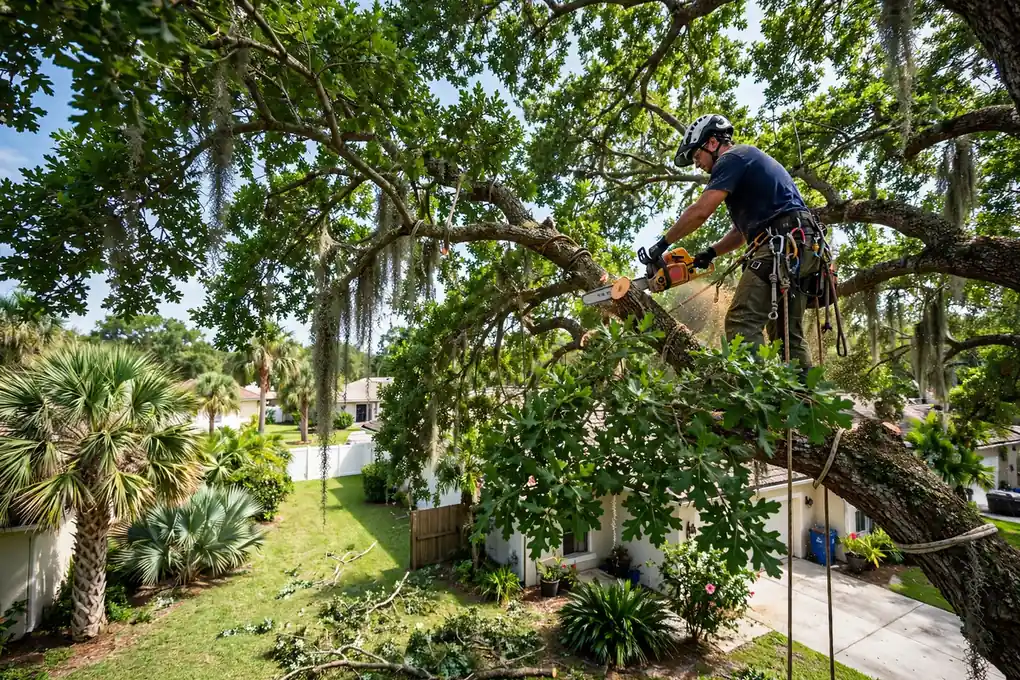
A deadwood job begins with a ground walk to identify targets: roofs, driveways, walkways, play areas, pool cages, and parked cars that set the priority order. The operator then works the canopy from the top down or from the outside in, depending on the tree's structure, cutting each dead limb at the branch collar where possible so the wound can close cleanly, and lowering larger pieces on rigging lines where they overhang a structure. Small dead twigs are allowed to fall into a clear drop zone and are chipped on site; nothing is left hanging or hung up in lower branches, a common flaw in rushed work that creates a delayed hazard.
Ground crew keep the drop zone clear, feed the chipper continuously, and rake the work area as the job progresses rather than leaving a single mountain of debris for the end. For trees over pool cages or delicate landscaping, we use extra rigging and, where needed, a crane to lift pieces vertically out of the canopy. The job ends with a ground-level review: the crew leader walks the canopy visually from several angles with you, confirms the priority limbs are gone, and notes any live-limb work — thinning, reduction, or cabling — worth scheduling next. Most single-tree deadwood passes take one to three hours including cleanup.
Deadwood, Storm Season, and Insurance Reality
Before hurricane season, deadwood removal is arguably the highest-value preparation a Lehigh homeowner can buy. In high wind, dead limbs are the first material to become airborne debris, and they become projectiles that damage neighboring properties as well as your own. Insurers and adjusters increasingly distinguish between storm damage to a well-maintained tree and damage traceable to long-deferred deadwood; a documented annual deadwood pass, with photographs, supports the position that the property was maintained. For HOAs and rental owners, that documentation also demonstrates duty of care across a community or portfolio.
Timing guidance is simple: mature trees should receive a deadwood pass at least annually, and ideally each spring before June. After any significant storm, a follow-up pass catches limbs that were cracked but not fully detached — the so-called hangers that fall days later when the wood dries and shrinks. If your tree shed an unusual amount of dead material in the last storm, that is information, not just mess: it suggests the canopy is aging, the crown is too dense, or the tree is declining, and a hazard assessment is the right next step. Call (239) 686-1550 and we will tell you honestly which of those applies.
Booking Deadwood Removal Across Lehigh Acres
Deadwood removal is priced per tree after a free on-site assessment, and it is frequently combined with trimming, thinning, or palm work on the same visit to save a second trip charge. Properties with several mature trees — common in the older neighborhoods near Lee Boulevard, Homestead Road, and Leeland Heights, and on acreage toward Olga and Buckingham — are quoted as a package with priority order, so the limbs over the house and driveway come out first even if the full property takes more than one visit. We serve Lehigh Acres plus Fort Myers, Cape Coral, Gateway, and North Fort Myers with the same standards and cleanup.
Call (239) 686-1550 Monday through Saturday, 7:00 AM to 6:00 PM, for a free deadwood estimate. We will walk your trees, show you what is dead and what is merely dormant, and leave a written quote. It is a small, quiet job with an outsized safety payoff — the kind of maintenance that never makes a dramatic story precisely because it prevents one.
Deadwood in Palms, Pines, and Oaks: Different Risks, Different Passes
Deadwood is not one uniform problem; its risk depends on the species carrying it. In live oaks, deadwood accumulates inside a dense crown where shaded limbs die slowly, and the danger is a heavy, hidden limb dropping onto a roof or driveway without warning. In slash pines, dead lower limbs become brittle spars that snap in wind and shed bark and branches onto everything below, while the dead crown of a declining pine can shed material for months. In palms, dead fronds hang by fibers and drop as heavy, stalked missiles that tear pool cages and dent cars, and they also harbor pests that attack the living crown. A deadwood pass must therefore be species-aware, not a generic sweep, and our crews adjust technique, rigging, and priority order to the trees actually on the property.
That species awareness also determines what a deadwood pass reveals. Heavy oak deadwood often signals a crown too dense for its own health and points toward thinning at the next visit. Pine deadwood concentrated on one side may indicate root damage or a lightning strike on that side. Palm dead material combined with a thinning crown points toward disease that trimming cannot cure. In each case the deadwood pass is both treatment and diagnosis, and the written summary you receive connects the dead material removed to the follow-up the tree actually needs, so a simple, affordable service becomes the entry point to a genuinely informed tree care plan.
What It Costs in Lehigh Acres
| Deadwood location | Danger level | Priority |
|---|---|---|
| Over roof / driveway | High — people and property below | Remove immediately |
| Over pool cage | High — cage and swimmers | Remove immediately |
| Interior canopy | Medium — falls within crown first | Annual pass |
| Over lawn / open ground | Lower — still a hazard | Include in annual pass |
| Hangers after storm | High — delayed failure likely | Urgent follow-up pass |
Every job is quoted free on site, so the number you approve is the number you pay. Call (239) 686-1550 and we will walk the property with you, explain the options in plain language, and leave a written estimate.
What Our Customers Say
They found dead limbs I never saw from the ground. The yard feels safer and the tree looks healthier.
Annual deadwood pass before hurricane season — simple, affordable, and our insurer liked the documentation.
Fast, careful work over our pool cage. Not a single tile or screen damaged.
Frequently Asked Questions
How often should deadwood be removed?
At least annually for mature trees, ideally each spring before hurricane season, plus a follow-up pass after major storms.
Can dead limbs fall in calm weather?
Yes. Dead wood has no flexibility and fails without warning, which is why regular removal matters even outside storm season.
How is deadwood removal priced?
Per tree after a free on-site assessment. It is often combined with trimming or thinning on the same visit.
Will you remove all deadwood or just the big limbs?
All dead limbs we can safely reach, from heavy spars to small twigs, because even small pieces damage cages and gutters.
Does deadwood removal help with insurance?
A documented maintenance history supports claims by showing the tree was cared for, rather than damage being deferred maintenance.
Do you work on palms too?
Palm dead fronds and boots are handled under our palm trimming service, which uses palm-specific techniques.
Ready to Get Started?
Free on-site estimates across Lehigh Acres, Monday to Saturday, 7:00 AM to 6:00 PM. Licensed & insured crews, tidy cleanup, honest pricing.
Find Us in Lehigh Acres, FL
We serve homes and businesses throughout Lehigh Acres and Lee County.