Remove vs Trim: How to Decide
Trimming solves today's problem and removal solves it permanently, so the choice depends on health, structure, and location. Use this walkthrough to decide with facts instead of worry.
Start With the Tree's Future, Not Just Today's Problem
Most homeowners call about a tree because something is bothering them today: shade on the wrong part of the yard, limbs over a roof, a messy palm, or a neighbor complaint. Trimming solves today's problem, removal solves it permanently, and the difference between those two answers is whether the tree still has a healthy future in its current spot. A sound tree in the wrong place can sometimes be pruned into a workable shape; a declining tree in the perfect place still needs to go. The decision guide below works by separating those two questions: is the tree healthy and structurally sound, and does its location still work for the property?
That separation matters because both mistakes are expensive. Removing a healthy tree you could have kept costs shade, property value, and years of growth that cannot be bought back quickly in Florida heat. Keeping a hazardous tree because you like it risks a roof, a fence, or a person, and the eventual emergency removal will cost more than a planned one. A professional assessment helps because it is based on trunk condition, canopy health, root stability, and clearance, not on sentiment or on the most recent storm memory. Walk through the factors in order and the answer usually becomes clear.
Signs That Point Toward Removal
Removal is the right call when the tree is structurally compromised beyond what pruning can fix. That includes a trunk with a large cavity or extensive decay, a split through a main crotch, a lean that has increased recently, heaving soil at the base, or a crown that is mostly dead. Disease that is systemic and incurable, such as lethal yellowing in a palm or Ganoderma butt rot, also points to removal, as does a tree whose roots have lifted a foundation, a driveway, or a septic system in a way that will keep getting worse. In those cases, trimming the canopy does not address the failure point, which is the trunk or the roots.
Location can force the same answer even for a healthy tree. A large species planted two feet from a house will keep growing into the roof and the foundation no matter how often it is pruned, and repeated heavy pruning will eventually weaken it. A tree directly over a power drop that the utility keeps cutting back into an unnatural shape is another candidate, as is a tree blocking a planned addition or a driveway that cannot be rerouted. In Lehigh Acres, where many lots were planted quickly during development booms, trees in the wrong place are common, and removing one to protect a home or to make room for a better-placed replacement is a sound investment, not a loss.
Signs That Point Toward Trimming
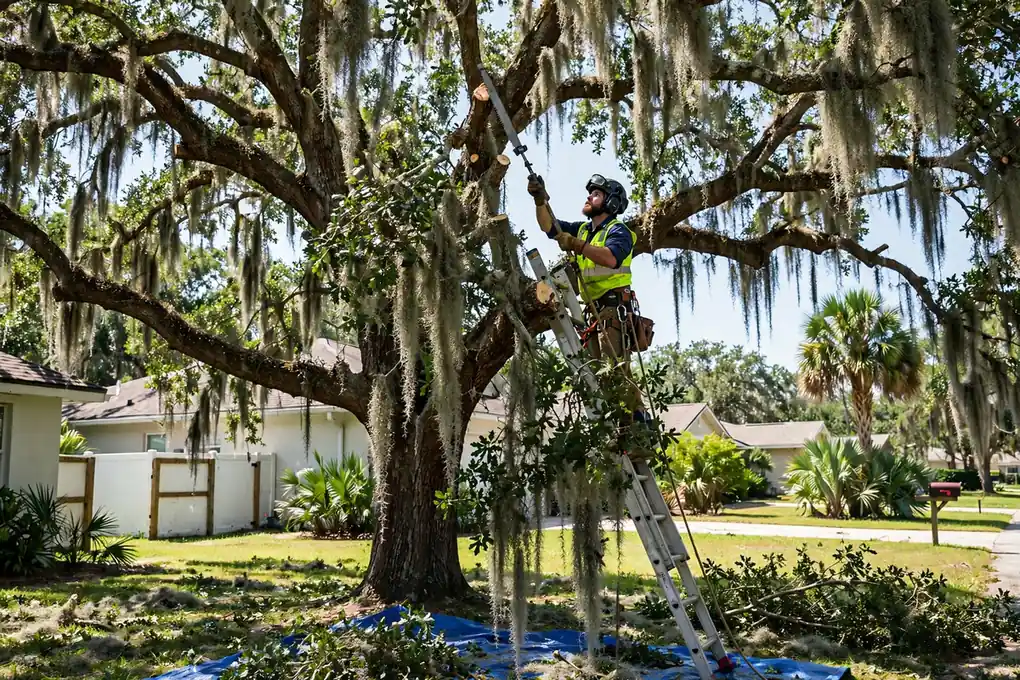
Trimming is the answer when the tree is fundamentally healthy and the problem is shape, clearance, or deadwood. A live oak with a few dead limbs, branches brushing the roof, or a canopy that has grown heavy on one side can usually be restored with careful pruning over one or two visits. Palms almost always fall in this category: regular trimming removes dead fronds, seed pods, and old boots, keeping the palm safe and attractive without touching its structure. Young trees with a minor structural flaw, such as a competing leader, often respond beautifully to corrective pruning that sets them up for decades.
Trimming also makes sense when the goal is light, view, or storm preparation rather than elimination. Crown thinning lets wind pass through and light reach the lawn, clearance pruning protects roofs and pool cages, and deadwood removal takes out the pieces most likely to fall. The key test is whether pruning leaves a balanced, healthy tree with a clear future. If the tree after pruning would still be lopsided, hollow, or leaning over a bedroom, then trimming was a cosmetic delay, not a solution. A good arborist will say so plainly rather than selling a trim that needs to be followed by a removal next year.
Cost, Timing, and the Middle Options
Cost often clarifies the decision in a practical way. A routine trim is far cheaper than a removal, and for a healthy tree it is money well spent every few years. But a tree that needs heavy, repeated trimming to stay safe, such as a fast-growing species hard against a house, can cost more over five years than a single removal plus a well-placed replacement. Compare the five-year picture, not just the next invoice, and include stump grinding and replanting in the removal side of the ledger. Removal pricing in Lehigh Acres typically runs $250 to $600 for small trees, $600 to $1,500 for medium trees, and $1,500 to $3,000 or more for large or hazardous trees, with palms and stump work priced separately.
There are also middle options worth knowing. Cabling and bracing can support a tree with a weak crotch that is otherwise healthy, buying years of safe life while the tree grows around the support. Crown reduction, as distinct from topping, can lower a tall canopy in a controlled way that preserves the tree's natural shape. Root pruning and barriers can sometimes manage a root conflict without removing the tree, though this needs care in sandy soil where roots are shallow. None of these are magic fixes for a dying tree, but for a borderline tree they can be the difference between keeping a valued shade tree and losing it.
A Simple Decision Walkthrough
Run through these questions in order. First, is the tree dead, dying, or structurally unsound? If yes, lean toward removal and get a professional confirmation. Second, does its location threaten a structure, a power line, or a septic system in a way pruning cannot permanently fix? If yes, removal or relocation of the problem, not the tree's canopy, is the issue. Third, is the problem limited to deadwood, clearance, or shape on an otherwise healthy tree? If yes, trimming is usually the right and cheaper answer. Fourth, what does the tree give the property in shade, privacy, and value, and can a replacement provide the same within a reasonable time?
If you still feel stuck after those questions, that is exactly what a free on-site assessment is for. An estimator can show you the cavity, the crack, or the root damage in person, explain what pruning would and would not achieve, and give you both prices so you can compare them honestly. The worst outcome is not choosing trim or removal; it is delaying the choice until a storm makes it for you at emergency rates. Call (239) 686-1550, walk the property together, and make the decision with facts rather than worry.
When a Second Opinion Is Worth Getting
Most trim-versus-remove decisions are straightforward once an arborist shows you the trunk, the canopy, and the root zone in person, but some deserve a second opinion, and knowing which ones saves both trees and money. Get another assessment when the recommendation is removal of a large, apparently healthy tree, when two companies disagree sharply about the same tree, or when the proposed price is far above or below other quotes without a clear explanation of scope. A second arborist may confirm the first recommendation, which gives you confidence to proceed, or may spot a cabling option, a root treatment, or a phased pruning plan that the first visit missed.
A second opinion is also wise when the tree has sentimental or historical value, shades a large part of the house, or anchors a landscape design that would take a decade to replace. In those cases, the cost of another site visit is small compared with the cost of losing the tree unnecessarily, and a good arborist will not be offended that you asked. Bring the first estimate to the second visit and ask directly where the two assessments differ: trunk condition, canopy health, root stability, or simply risk tolerance. The differences, once named, usually point to the right answer more clearly than either opinion alone.
Be wary, however, of collecting opinions until one tells you what you want to hear. If three experienced arborists independently recommend removal of a decaying tree over a bedroom, that consensus is itself information, and continuing to search for a trim recommendation puts the house at risk. The purpose of a second opinion is to test a borderline call, not to postpone an obvious one. Once you have a clear, documented recommendation, act on it in the calmer season if possible, and keep both assessments in your property file for future buyers, insurers, or HOA boards who may ask why the tree was kept or removed.
| Factor | Trimming usually wins | Removal usually wins |
|---|---|---|
| Trunk condition | Sound, no major decay | Cavity, split, extensive decay |
| Crown health | Mostly live, some deadwood | Mostly dead, spear collapsed |
| Lean and roots | Stable, no heaving | New lean, heaving soil, lifted structure |
| Location | Clearance fixable by pruning | Growing into house, line, or septic |
| Disease | Treatable deficiency | Systemic, incurable disease |
| Long-term cost | Periodic trims, stable | Repeated heavy trims exceed removal |
Frequently Asked Questions
How do I decide between removing and trimming a tree?
Check health and structure first, then location. A healthy tree with a clearance or deadwood problem should be trimmed; a dead, decaying, or structurally unsound tree, or one in an impossible location, should be removed.
Is it cheaper to trim a tree every year or remove it once?
A single routine trim is cheaper, but a tree that needs heavy trimming every year to stay safe can cost more over five years than one removal plus a well-placed replacement. Compare the five-year picture.
Can cabling save a tree I would otherwise remove?
Sometimes. Cabling and bracing can support a healthy tree with a weak crotch, buying years of safe life. They cannot save a dead or extensively decayed tree.
Should I remove a healthy tree that is too close to my house?
Often yes, if pruning cannot permanently solve the conflict. A large tree two feet from a foundation will keep growing into the structure, and repeated heavy pruning weakens it.
Do I need a professional to make this decision?
For any tree near a structure, it is wise. An arborist can show you decay, cracks, or root damage that are easy to miss from the ground and give you both prices to compare.
Related Reading
For local help with the topics above, see our tree service blog, our tree removal cost guide, and our storm damage cleanup service. For a free on-site assessment anywhere in Lehigh Acres, call (239) 686-1550 or visit our contact page.
Free On-Site Estimates Across Lehigh Acres
Licensed and insured, 4.9 rated from 180+ reviews, with 2,400+ jobs completed over 14+ years. Call (239) 686-1550 today.